
Non-Invasive Electricity Monitoring for Factories: A Proven European Blueprint for Malaysian Industry
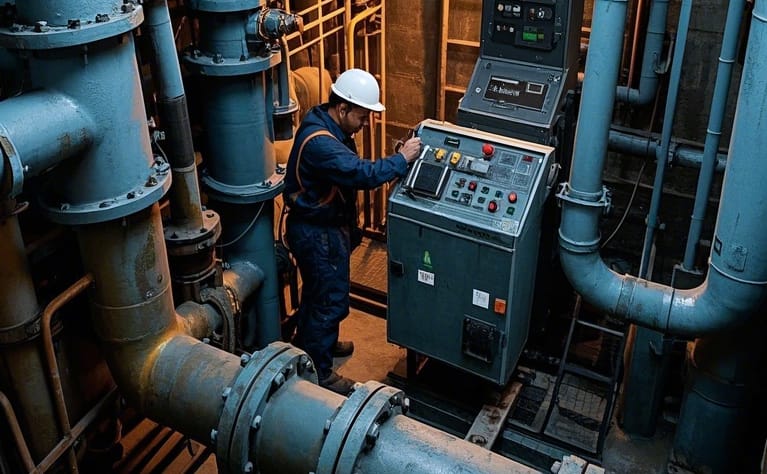
Electricity is one of the largest controllable costs in any manufacturing operation — yet most factories run entirely blind to what their individual machines are actually consuming moment to moment. A deployment across European manufacturing facilities shows exactly how a non-invasive, wireless IoT approach can change that, and the results translate directly to Malaysia’s industrial landscape.
The Problem: Flying Blind on Machine-Level Power
Manufacturing facilities typically know their monthly electricity bill. What they almost never know is which machine, production line, or shift is responsible for which share of it. Without machine-level visibility, inefficiencies are invisible: a press running 15% above its rated consumption, a compressor cycling unnecessarily during off-peak hours, or a conveyor left running through a lunch break all disappear into the aggregate meter reading.
The result is chronic overspend on energy, unexpected maintenance costs from machines that degrade silently, and no data to drive smarter production scheduling. Traditional sub-metering addresses this in theory — but in practice, running dedicated wiring to every machine in a live production environment is expensive, disruptive, and often impractical.
The Solution: CT10x Smart Current Transformers on Every Machine

Working with IoT platform partner Heliotics, a European manufacturer deployed Milesight CT10x Smart Current Transformers across 10 machines — around 30 devices in total, covering each machine’s three phases. The CT10x’s split-core design clamps directly around existing conductors with no need to break the circuit, no qualified electrician sign-off after installation, and no external power supply. It harvests energy from the monitored conductor itself.
Data transmits wirelessly over LoRaWAN® to a gateway and into the Heliotics CORE platform, which recalculates raw current readings into kWh consumption, tracks cost in multiple currencies, and surfaces anomalies and trends through an intuitive dashboard. Configuration is handled via USB-C or the Milesight Toolbox app — no specialist tools required.
Results That Speak Directly to the Bottom Line
- 21% reduction in energy costs — achieved by identifying and eliminating machine inefficiencies, optimising production scheduling to off-peak tariff hours, and preventing energy waste during idle periods.
- 17% drop in unplanned downtime — anomalous consumption patterns (unexpected spikes, irregular cycling) flagged potential mechanical issues early, enabling predictive maintenance before failures occurred.
- Actionable cross-machine benchmarking — comparing machines doing identical work revealed which units were underperforming and needed attention, converting a gut-feel maintenance programme into a data-driven one.
- Zero installation disruption — the entire deployment was completed without stopping production, without new cabling, and without electrical safety inspections triggered by wiring changes.
Why Malaysian Manufacturers and Industrial Parks Need This Now
Electricity Tariffs Are Rising and Will Continue To
Malaysia’s industrial electricity tariffs have increased across successive Tenaga Nasional Berhad (TNB) tariff reviews, and the direction of travel under the government’s subsidy rationalisation programme is clear. For energy-intensive manufacturers — automotive, rubber, plastics, food processing, electronics assembly — energy as a percentage of operating cost is climbing. A 21% reduction in machine-level consumption is no longer a nice-to-have; for many facilities it represents the difference between a competitive and an uncompetitive cost structure.
Malaysian Industrial Tariffs Reward Off-Peak Scheduling
TNB’s industrial tariff structure includes time-of-use (ToU) components — peak, off-peak, and mid-peak rates — that reward factories for shifting energy-intensive operations to lower-cost periods. The Heliotics CORE platform’s per-machine energy tracking, combined with CT10x real-time monitoring, provides exactly the visibility needed to implement intelligent production scheduling around tariff windows. Without machine-level data, ToU optimisation is guesswork.
The Non-Invasive Advantage Is Critical in Malaysian Factories
Malaysian manufacturing facilities — particularly older plants in Penang’s industrial zones, Shah Alam, Pasir Gudang, and Johor’s southern corridor — often have legacy electrical infrastructure where adding conventional sub-metering would require significant rewiring and mandatory electrical inspection under the Electricity Supply Act 1990. The CT10x’s non-invasive clamp design sidesteps this entirely: no wiring changes, no triggered inspection obligation, no production shutdown. A facility manager can begin monitoring a machine within minutes of receiving the device.
MIDA and Green Lane Incentives Are Aligned
The Malaysian Investment Development Authority (MIDA) and the Green Technology Financing Scheme (GTFS) both offer incentives for manufacturers that demonstrate measurable energy efficiency improvements. IoT-based energy monitoring produces exactly the auditable, timestamped, machine-level consumption data that supports Green Investment Tax Allowance (GITA) applications and Carbon Reduction Certification under the National Carbon Registry. Deploying CT10x sensors is not just an operational decision — it can be part of a structured ESG and incentive capture strategy.
Industrial Parks: A Natural Roll-Out Unit
Malaysia’s industrial park operators — including Iskandar Investment, PKNS, MIEL, and private REIT-managed parks — are increasingly required to report aggregate tenant energy consumption for sustainability disclosures. A standardised CT10x deployment across tenanted facilities would give park operators real-time energy dashboards, aggregate kWh and carbon reporting, and early warning of facilities consuming abnormally — all without intruding on tenant operations.
Practical Entry Point
A pilot deployment monitoring one production line — typically 3 to 9 machines, 9 to 27 CT10x units — costs a fraction of conventional sub-metering and delivers baseline data within the first billing cycle. Payback on energy savings alone typically falls within 12–18 months at Malaysian industrial tariff rates; the predictive maintenance benefit accelerates this considerably.
Products Involved
The CT10x is available in three current range variants — CT101 (100 A), CT103 (300 A), and CT105 (500 A) — covering the full spectrum of typical industrial machine loads. For higher-current applications, the CT3xx series extends range to 1000 A. Both are stocked and supported by Riajati in Malaysia.
Getting Started
Riajati is an authorised Milesight partner in Malaysia. We can help you scope a pilot deployment for your facility — identifying which machines to instrument first, sizing the LoRaWAN® network, and connecting sensor data to your preferred analytics or ERP platform. Whether you manage a single factory or a multi-tenant industrial estate, we can design a system that fits your operational constraints and delivers measurable returns.
Contact us to discuss a pilot for your facility.
Source: Milesight — Scalable Non-Invasive Electricity Monitoring in European Manufacturing Facilities