Lightning at the Places We Go to Relax: The Hidden Risk on Golf Courses, Pitches, Beaches, and Parks
The same conditions that make recreational venues pleasant — wide-open ground, water, tall isolated structures, and crowds with nowhere obvious to hide — also make them disproportionately dangerous when a thunderstorm rolls in. Here is what the data and recent incidents tell us, and what venues can do about it.
Why recreational venues are over-represented in lightning incidents
Lightning is a strangely democratic hazard: it strikes nearly every country, and rarely strikes the same square kilometre twice in a season. But the people it kills are not randomly distributed. Across decades of National Weather Service casualty data, roughly half of all US lightning fatalities happen in just two settings — open or sports fields, and on or near water. Add yards, parks, and golf courses, and the picture narrows further: more than nine in ten lightning deaths happen outdoors, and most occur during leisure rather than work.
That bias becomes much sharper in the tropics. Vaisala’s 2024 global lightning report identified Kuala Lumpur as having the highest average lightning density of any sub-country area in the world, and ranked Indonesia among the top five countries for total lightning over land. Independent Malaysian studies put the country’s annual lightning fatality rate at roughly six per million people — about twenty times the rate in the United States — with the majority of casualties occurring outdoors during sports and leisure activities, peaking in April and May.
For venue operators, that combination is the worst possible: high storm frequency, high outdoor occupancy, and a population that has not historically been warned in time.
Where it happens — and why
The venue breakdown matters because the right response is different for each environment.
- Golf courses. Long fairways, isolated trees, raised umbrellas, and metal clubs make golfers a textbook lightning target. The US National Lightning Safety Council has tracked golf-related fatalities for two decades, and the toll continues every season.
- Football and rugby pitches. Open fields with no real shelter put 22 players and a referee in an exposed conducting circle. Lightning does not need to hit the pitch directly; ground-current spread from a nearby strike can fell multiple people at once.
- Beaches. Sand, shallow water, and crowds with little overhead cover form a near-perfect lightning trap. Strikes have killed swimmers in only ankle-deep water, with the parent storm cell sitting miles offshore.
- Public parks. Picnic shelters, jogging tracks, and play areas typically lack any storm-rated structure within the running distance a sudden squall allows. A flagpole, a single tall tree, or a metal climbing frame can become the most prominent strike target nearby.
- Outdoor stadiums. The scale changes the problem: tens of thousands of spectators cannot evacuate in the 5–10 minutes between detecting an approaching storm and the first cloud-to-ground flash.
Recent fatal incidents
These cases — drawn from regional and international venues, with the Malaysian one delivering a verdict only in mid-2025 — illustrate how the danger looks at ground level, and how the legal aftermath can extend years beyond it.
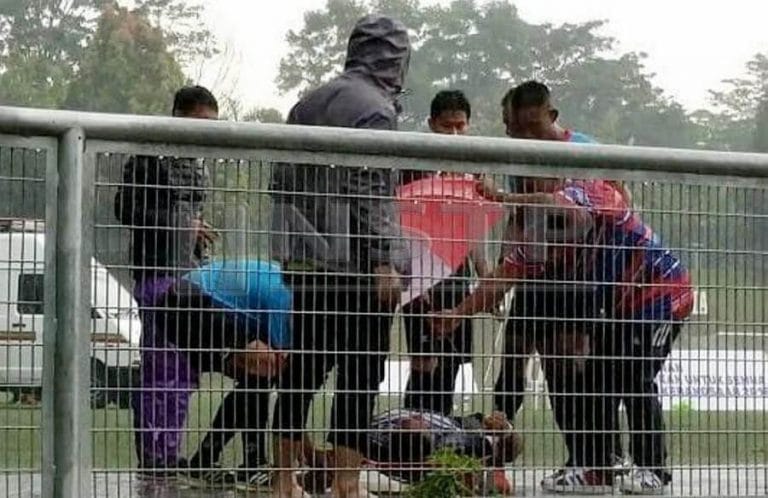
- Hang Jebat Stadium, Melaka, Malaysia (April 2016 — verdict June 2025). Two Melaka United players were struck during a routine training session. Australian-born goalkeeper Stefan Petrovski, 18, never regained consciousness and died four weeks later; defender Afiq Azuan survived. In June 2025, the Melaka High Court ordered the Melaka United Soccer Association to pay nearly RM700,000 in damages, ruling that the club had failed to provide a safe training environment — no AED on site, no doctor present, no personal accident insurance, and training continued despite worsening weather. It is the clearest local precedent that venue lightning safety is now a documented duty of care.
- Peru, November 2024. A 39-year-old defender, Hugo De La Cruz Meza, was killed and five others injured at Coto Coto stadium in Chilca after lightning struck the pitch seconds after the match had already been suspended. Video footage shows the players walking off when the strike hit.
- Indonesia, February 2024. Septain Raharja was struck and later died in hospital after lightning hit during a friendly match — the second high-profile player fatality of its kind in the country within a year.
- Ballyowen Golf Course, New Jersey, July 2025. Simon John Mariani, 28, was struck on the 15th hole during an all-day “Iron Man” tournament. Course staff had sounded a storm alarm; he was injured on the way to shelter and died six days later.
- The Bridges Golf Course, Texas, June 2025. A father and son were struck together on the course; the son, in his forties, died at hospital.
- New Smyrna Beach, Florida. A 29-year-old honeymooner was killed while standing in ankle-deep water at the shoreline. The active storm cell was several miles offshore — exactly the situation safety officials call out as the most underestimated scenario.
The common thread in nearly every incident is not that no one knew lightning was possible. It is that the warning either was not specific enough to the site, or did not arrive far enough ahead of the first strike for everyone to actually reach shelter.
What “safe” actually means: the 30/30 rule and where it falls short
The widely promoted 30/30 rule, endorsed by NOAA and the National Lightning Safety Institute, gives the public a workable shorthand: if you see a flash and hear thunder within 30 seconds of each other, the storm is within about 10 km — stop everything and seek a substantial enclosed building or a hard-topped vehicle. Do not resume outdoor activity until 30 minutes have passed since the last thunder or visible flash.
The rule is sound, but it has three operational limits venues must understand:
- It assumes someone is watching the sky and timing flashes. In a tournament, a busy beach, or a packed stadium, no one is.
- It is reactive. By the time you can hear thunder, you are already inside the lightning’s reach.
- It does not extend the warning window. The rule starts the clock when the storm arrives — it cannot give you the 15–30 minutes of lead time needed to evacuate a venue of any meaningful size.
That gap — between the moment a storm becomes detectable and the moment it becomes deadly — is exactly what dedicated lightning warning systems exist to close.
Where automated detection fits in
Modern lightning-warning instruments do two things the human eye cannot. They detect the early electrostatic signatures of a developing storm well before the first cloud-to-ground stroke, and they continuously track the local risk so a venue receives both the approach warning and the all clear without requiring anyone to be staring upward.
For sports and leisure venues, the practical performance characteristics that matter are:
- Detection of overhead charge build-up, not only flashes that have already occurred
- A local range that covers the venue plus a sufficient buffer for evacuation (typically 8–16 km)
- An unambiguous “warn now” trigger that can drive a siren or PA system automatically
- A rolling all-clear timer so play does not resume prematurely
The Biral BTD-200 and BTD-300 thunderstorm detectors, distributed in Malaysia by Riajati, are designed around exactly that operational pattern. They have already been deployed at outdoor venues in the region precisely because their detect-then-evacuate window fits how stadiums, golf courses, and parks actually operate. The same lightning detection and surge-protection product range covers complementary needs for permanent installations, including detectors from Dinnteco, Sertec, and other specialist manufacturers in the Riajati Lightning category.
Working with Riajati
If your venue — a stadium, a golf club, a sports complex, a beachfront resort, or a public park system — has lightning exposure and no automated warning beyond someone watching the sky, we can scope a system that fits the site, the crowd size, and the evacuation reality. A typical engagement starts with a site assessment to determine sensor placement, siren coverage, and integration with existing PA or scoreboard infrastructure. Talk to us at sales@rj.my or see our recent case study on the Biral BTD-200 in Malaysia.
Sources: National Weather Service lightning safety and fatality statistics; National Lightning Safety Council annual fatality reports; Vaisala / Xweather 2024 Annual Lightning Report; NOAA Jetstream Lightning Safety; reporting on individual incidents from CNN (Peru, Nov 2024), Mothership (Indonesia, Feb 2024), Fox News (New Jersey, Jul 2025), Fox 4 Dallas-Fort Worth (Texas, Jun 2025), and NBC 6 South Florida (New Smyrna Beach). Malaysian fatality rate context from peer-reviewed studies summarised in the F1000Research lightning safety awareness review. The Stefan Petrovski case and June 2025 ruling are reported by Free Malaysia Today and the New Straits Times.