Real-Time Flood Monitoring with LoRaWAN: Lessons from Austria and Why Malaysia Needs This Now
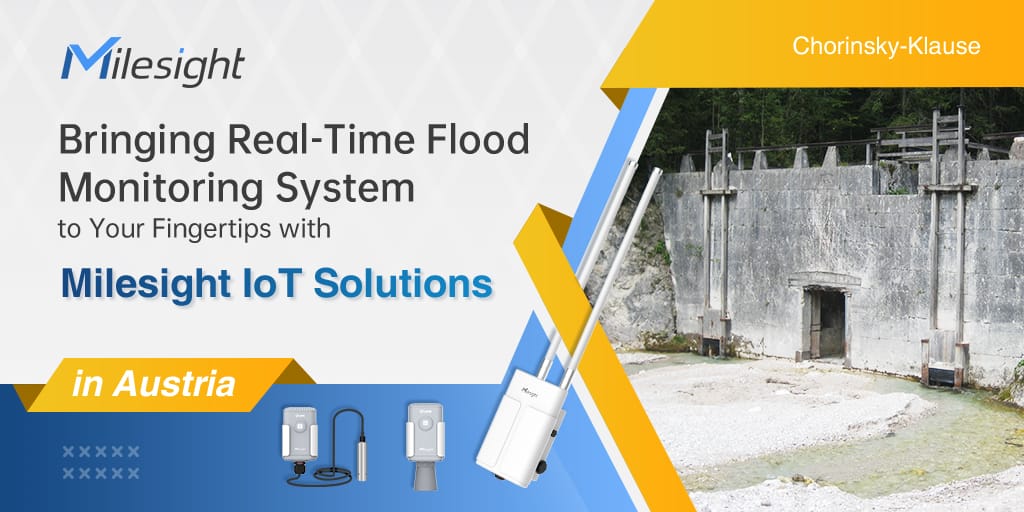
Every year, floods claim lives, destroy property, and disrupt communities across Malaysia. The technology to provide real-time early warning — continuously monitoring water levels, transmitting data wirelessly over kilometres, running on solar power with no infrastructure dependency — already exists and has been proven in deployment. An engineering project in the Austrian Alps shows exactly how it works.
The Challenge: A Remote Dam With No Eyes
The Chorinsky-Klause is a historic 19th-century dam in the Weißenbach Valley in the Austrian Alps. It protects a downstream settlement from flash floods — but the valley is so remote, accessible only by a narrow dirt road, that manual inspection was impractical and dangerous, particularly in winter. Staff had no way to check water levels at the dam without physically driving there. There was no mains electricity at the dam site, no cellular data coverage sufficient for conventional monitoring, and wired network deployment would have been prohibitively expensive.
The question Hartl Consulting set out to answer was: can a fully wireless, solar-powered sensor network provide the same situational awareness as a human inspector — continuously, remotely, and affordably?
The Solution: Two Gateways, Three Sensors, Zero Wires
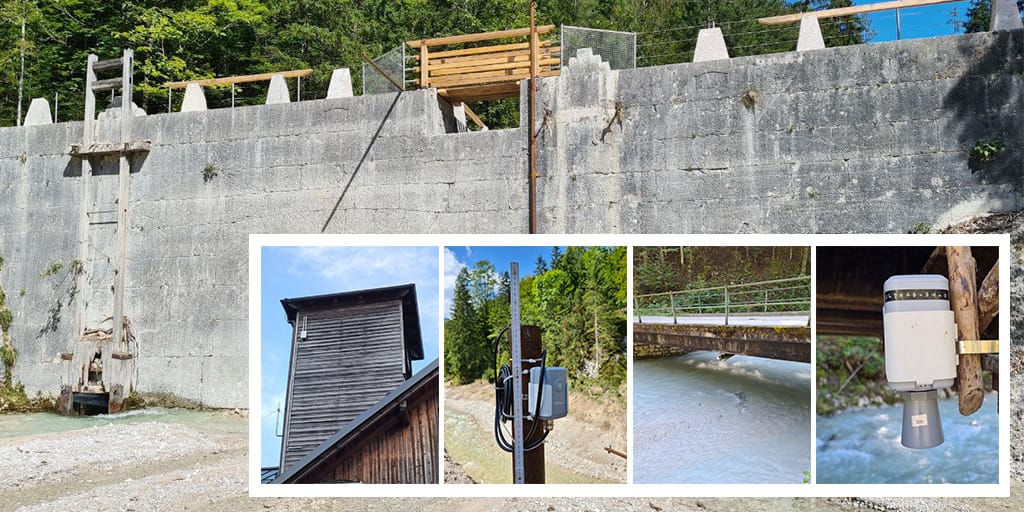
Hartl Consulting, partnering with Milesight, deployed the following hardware:
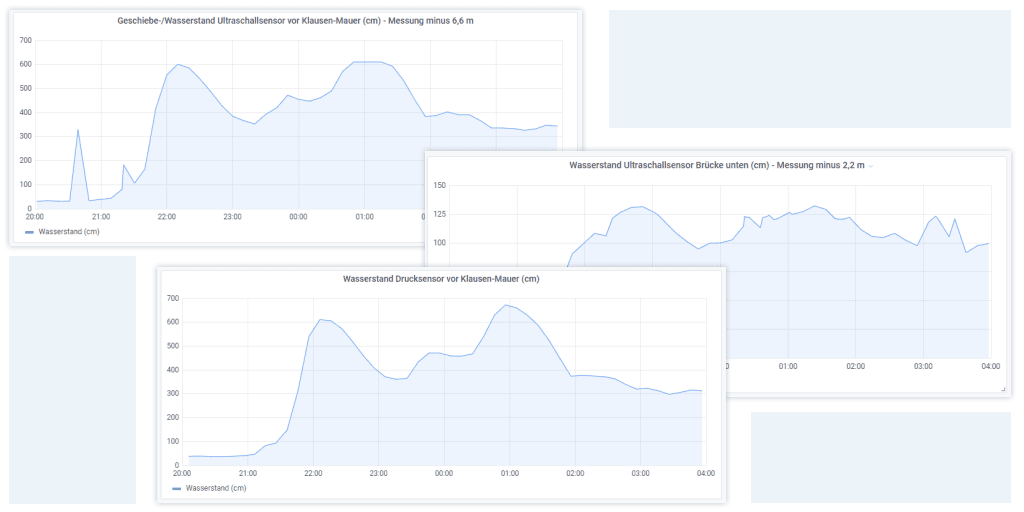
- Milesight EM500-UDL Ultrasonic Distance/Level Sensor — mounted above the dam to measure upstream water level every 10 minutes without contact with the water surface.
- Milesight EM500-SWL Submersible Water Level Sensor — installed in the water next to the dam for a second, independent upstream measurement.
- A second EM500-UDL deployed further downstream to track water levels below the dam after any discharge event.
Two Milesight UG67 Outdoor LoRaWAN® Gateways cover the project area. The first sits on a fire brigade tower at the valley entrance with grid power. The second is positioned right beside the dam, running entirely on an existing solar panel with a GSM antenna for backhaul — proving the system works with zero dependence on mains electricity or wired connectivity.
Sensor data flows through The Things Network → MQTT → a PostgreSQL database → visualised live in Grafana.
Results
- Continuous remote visibility — staff can see current water levels, historical trends, and precipitation data from any browser without visiting the site.
- Early flood warning — rising upstream levels give the downstream settlement advance notice to prepare or evacuate, something impossible before deployment.
- Event documentation — the system archives timestamped water level records, enabling post-flood analysis to improve future preparedness.
- Dramatic cost and time savings — manual inspection trips to the remote valley are now reserved for maintenance, not routine checks.
The project owners’ own assessment: “Before it wasn’t possible to check the water level of the dam without going there. This makes it far easier to see upcoming floods and to warn the people or analyze past events.”
Why Malaysia Needs This — Urgently
Austria’s challenge was remoteness. Malaysia’s challenge is scale, frequency, and consequence. Flash floods and river floods are among the most damaging recurring disasters in the country — and the monitoring infrastructure to manage them in real time remains severely underdeveloped across most of the peninsula and East Malaysia.
The Flood Problem in Numbers
Malaysia experiences flooding year-round, driven by two northeast monsoon seasons (November–March) and localised convective rainfall throughout the year. The December 2021 Klang Valley floods — among the worst in decades — caused over RM6.1 billion in damages and displaced more than 70,000 people. Kelantan, Terengganu, Pahang, Johor, and Sabah face annual inundation events that destroy crops, cut off communities, and strain emergency services. A 2023 DID (Department of Irrigation and Drainage) report identified more than 900 flood-prone areas across Malaysia requiring improved monitoring coverage.
The Gap: Manual Monitoring Can’t Scale
Malaysia’s existing flood monitoring network, operated by DID, relies on a mix of telemetry stations, rain gauges, and manual staff patrols. Coverage is uneven — urban rivers near Kuala Lumpur have reasonable instrumentation, but rural rivers in Kelantan, the Rajang basin in Sarawak, or the Kinabatangan floodplain in Sabah have sparse or no automated monitoring. Even where stations exist, they are expensive to install and maintain, and gaps in coverage mean that many flood events develop without warning.
LoRaWAN-based monitoring directly addresses this gap. Sensors can be deployed at any point along a river, retention pond, or drainage channel without grid power or wired connectivity. A solar-powered gateway covers a 5–15 km radius, enabling dense sensor networks at a fraction of the cost of conventional telemetry infrastructure.
Five Specific Applications in the Malaysian Context
1. Rural river flood early warning (Kelantan, Pahang, Terengganu, Sarawak)
Rivers like the Kelantan, Pahang, and Rajang have long stretches with no monitoring. Deploying EM500-UDL or EM500-SWL sensors at strategic gauging points — powered by small solar panels, connected via LoRaWAN to solar-powered UG67 gateways — would give DID and state emergency management offices real-time level readings and automatic alerts when thresholds are breached. Communities downstream could receive warnings hours earlier than today’s manual systems allow.
2. Urban flash flood management (Klang Valley, Penang, Johor Bahru)
The Klang Valley’s dense stormwater infrastructure — retention ponds, box culverts, SMART tunnel — requires rapid response when intense rainfall overwhelms capacity. Sensor networks monitoring retention pond levels, culvert flows, and low-lying road underpasses in real time would give DBKL, Penang Island City Council, and MBJB the data they need to trigger pump operations, close flood-prone roads, and alert residents before inundation occurs rather than after.
3. Agricultural floodplain management (MADA, KADA rice granaries)
The Muda and Kemubu agricultural development areas — Malaysia’s main rice-producing regions — are vulnerable to both drought and flood. Water level monitoring across irrigation channels, inlet gates, and field drains would allow DID and MADA/KADA to manage water distribution more precisely, protect standing crops during flood events, and reduce the post-harvest losses that follow undetected inundation.
4. Coastal and estuarine monitoring (tidal backflow flooding)
Many of Malaysia’s coastal towns — Kota Tinggi, Batu Pahat, Kuala Terengganu — experience flooding driven not by upstream rainfall alone but by tidal backflow coinciding with peak river discharge. Monitoring both river levels and tidal height simultaneously with LoRaWAN sensors would give authorities visibility of the combined risk and allow more precise timing of tidal gate operations.
5. Slope and reservoir monitoring (Cameron Highlands, Frazer’s Hill, Sabah highlands)
Highland areas prone to landslide-triggered flash floods — including the Cameron Highlands, parts of Sabah’s interior, and Sarawak’s hill terrain — require monitoring of both rainfall accumulation and soil moisture, not just downstream water levels. The Milesight EM500 series, combined with precipitation sensors and LoRaWAN connectivity, provides the multi-parameter sensing needed for early landslide-flood warning.
Infrastructure Advantages That Make LoRaWAN the Right Choice for Malaysia
The Austrian deployment worked precisely because LoRaWAN removes the dependencies that make conventional monitoring expensive and slow to deploy: no wired power, no cellular data subscription, no specialist installation crew. These same advantages matter even more in Malaysia’s context:
- Solar self-sufficiency — Malaysia’s equatorial sunlight provides more reliable solar energy than the Austrian Alps, making solar-powered gateways and sensors even more dependable year-round.
- Existing LoRaWAN coverage — Telekom Malaysia and several private operators have been building out LoRaWAN network infrastructure under the MyDIGITAL initiative, providing ready-made connectivity in many areas without even requiring private gateway deployment.
- Scalable sensor density — a single UG67 gateway can serve dozens of sensors across a wide area; adding monitoring points along a river is simply a matter of installing additional sensors, not new gateways.
- IP67/IP68 ruggedisation — the EM500 series sensors are rated for full immersion and sustained outdoor exposure, essential for deployment at flood-prone riverbanks subject to periodic inundation.
Alignment with National Policy
The National Disaster Management Agency (NADMA), the Department of Irrigation and Drainage (JPS/DID), and state emergency management committees (SEMC) are all responsible for flood monitoring and early warning. The National Flood Forecasting and Warning System (SMART) and the ongoing Integrated River Basin Management programme both identify real-time monitoring network expansion as a priority. LoRaWAN-based deployments offer the fastest and most cost-effective path to closing the coverage gap identified in DID’s own assessments.
Getting Started
Riajati is an authorised Milesight partner in Malaysia. The EM500-UDL, EM500-SWL, and UG67 outdoor gateway used in the Austrian deployment are all available locally, with full support for network design, sensor placement, and platform integration. Whether you are a local authority, a river basin authority, an agricultural development agency, or a private developer managing retention infrastructure, we can help scope and deploy a monitoring system suited to your catchment and alert requirements.
Contact us to discuss a flood monitoring deployment for your area.
Source: Milesight — Real-Time Flood Monitoring with LoRaWAN in Austria (Hartl Consulting)