Biral BTD Lightning Detection — 14 Years of Field-Proven Performance
A 14-year track record built on quasi-electrostatic detection
In early June 2012, a prototype sensor on the rooftop of a small instrument maker in Portishead, UK detected its first thunderstorm. Fourteen years later, that same family of sensors — Biral’s BTD-300, BTD-350, and BTD-200 — has shipped more than 250 units worldwide, including a growing number across Malaysia, Singapore, Indonesia, Thailand, the Philippines, and Vietnam. The original Portishead BTD-300 is still running. As of 2026 it has logged approximately 140 thunderstorms within 20 km of the sensor — a rolling, real-world endorsement of an instrument designed to be quiet, reliable, and low-maintenance.
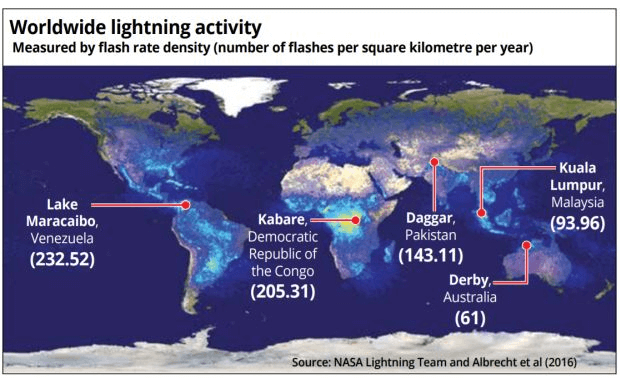
For sites in the ASEAN monsoon belt — where Kuala Lumpur alone sees 200+ thunderstorm days a year — that 14-year reliability record isn’t an abstraction. It’s the difference between a lightning warning system that’s still serving an offshore platform a decade after install and one that’s been quietly replaced twice.
What makes a BTD different
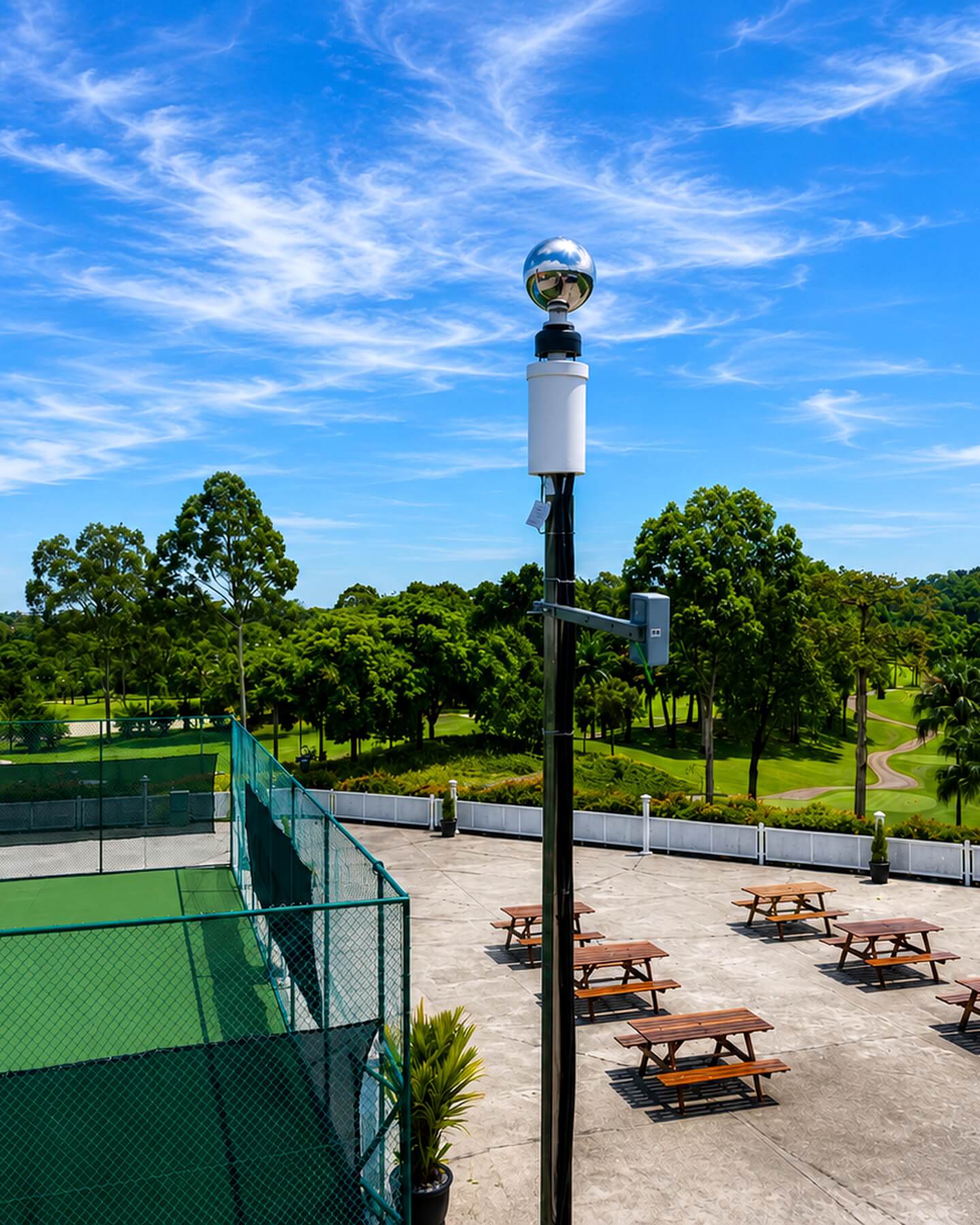
Most consumer-grade lightning detectors look for the radio-frequency “crack” of a strike that’s already happened. Biral’s BTDs use a different physical principle: a quasi-electrostatic measurement that detects the slow buildup of electric charge in the air before a storm arrives. That’s how the system can warn of an approaching thunderstorm minutes before the first cloud-to-ground flash — long enough to evacuate a tarmac, shut down a blast pattern, or stop a refueling operation.
The principle is fully passive — no moving parts, no transmitter, no calibration drift. It’s the same physical phenomenon meteorologists used to measure with field mills decades ago, miniaturised into a sealed sensor head.
The three models, what they’re for
BTD-300 — the airport workhorse
The BTD-300 Thunderstorm Detector is Biral’s flagship long-range unit. With an 83 km detection radius and a sub-2% false-alarm rate, a single BTD-300 reliably covers a major airport, an entire wind farm, or a large industrial site. It outputs hard-wired data to any control system and offers optional direction-of-strike for storm tracking. Civil aviation authorities worldwide have adopted it as part of meteorological observing systems; CAP 437 and CAP 746 compliance makes it directly suitable for helideck operations.
BTD-350 — engineered for marine
The BTD-350 shares the BTD-300’s detection physics but adds reinforced vibration resistance, stainless-steel construction, and marine-grade paint for offshore platforms, support vessels, and offshore wind sub-stations. Mounted on a service vessel, it becomes a mobile warning system that travels with operations between wind farms — a meaningful operational advantage when crews work on different sites week to week.
BTD-200 — the affordable entry point
In May 2017, Biral launched the BTD-200 Lightning Warning System — a simpler, modular unit aimed at sites that don’t need the BTD-300’s range. The BTD-200 covers a 35 km radius (≈22 miles), connects to a Windows PC running Biral’s Lightning Works software, and is designed to be installed by non-specialist contractors. It’s become the go-to choice for outdoor sports venues, schools, construction sites, and leisure operations across ASEAN where a full BTD-300 installation isn’t cost-justified.
Why 14 years of field data matters
Lightning detection vendors come and go. What distinguishes the BTD family is the unbroken chain of operational data behind the technology. Every firmware revision, every detection-efficiency claim, every site-selection guideline — all of it is backed by 14 years of measurements from the original Portishead unit and from 250+ deployed sensors logging real storms in real conditions.
For an industrial site manager evaluating lightning warning systems, that translates to less guesswork. Detection thresholds aren’t tuned on simulations; they’re tuned on hundreds of recorded storm cells. False-alarm rates aren’t theoretical; they’re observed.
What we recommend for ASEAN sites
Riajati has been deploying BTD systems across Malaysia and the wider ASEAN region for years. A few notes from the field:
- For airports and large industrial sites — start with the BTD-300. Its 83 km radius means a single unit covers the entire facility plus approach paths, and aviation compliance is already done.
- For offshore wind, oil & gas platforms, and marine operations — the BTD-350 is the only sensible choice. The marine hardening matters more than people expect in equatorial humidity.
- For solar farms, schools, sports venues, and outdoor events — the BTD-200 is sized right. Pair it with Lightning Works software and you have a warning system a site manager can run without specialist training.
See our Biral lightning installations page for reference deployments and case studies across the region.
Talk to us
Lightning detection isn’t a commodity decision. The right sensor depends on the site’s risk profile, the operational decisions the warnings need to support, and what the existing control infrastructure looks like. Contact our lightning systems team — we’ll walk through it with you.
This article draws on Biral’s original “10 Years of BTD Technology” announcement and our own deployment experience across ASEAN.