Real-Time Air Quality Monitoring for Airports: How Turkish Airports Did It and Why Malaysia Needs It

Millions of passengers pass through airports every year breathing air they never think about — until it becomes a problem. A deployment across three major Turkish airports shows exactly how IoT sensor technology can take air quality from a passive background concern to an actively managed, measurable parameter. The implications for Malaysia’s airports are direct and compelling.
The Challenge: Air Quality Blind Spots at Scale
TAV Airports operates İzmir Adnan Menderes, Ankara Esenboğa, and Bodrum Milas-Bodrum airports — all experiencing rising passenger volumes in 2024. The challenge wasn’t that the air was dangerous; it was that no one really knew what it was at any given moment. Waiting lounges, boarding gates, and food courts all experience rapid swings in CO₂, temperature, humidity, and VOC levels as passenger density rises and falls across the day. Manual checks were too infrequent and too slow to catch these fluctuations, let alone trigger ventilation adjustments in time.
The Solution: 106 Wireless IAQ Sensors, Zero New Cabling
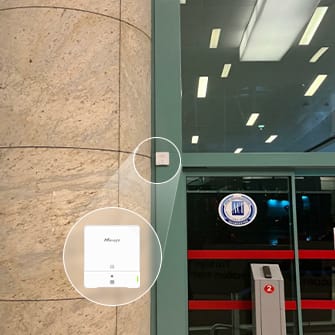
TAV worked with Milesight partner DVM IoT Solutions to deploy 106 Milesight AM308L 8-in-1 IAQ sensors throughout the terminals. Each unit continuously measures CO₂, temperature, humidity, atmospheric pressure, TVOC, light, noise, and PM2.5 — transmitting wirelessly over LoRaWAN® to a mix of Milesight UG63 indoor gateways and SG50 ultra-low-power solar gateways.
The entire network is cableless. Sensors are wall-mounted and battery-powered; gateways connect over existing ethernet or cellular backhaul. This made deployment fast, non-disruptive, and compatible with the operational constraints of a live airport environment.
Centralised Visibility via the Insight Platform
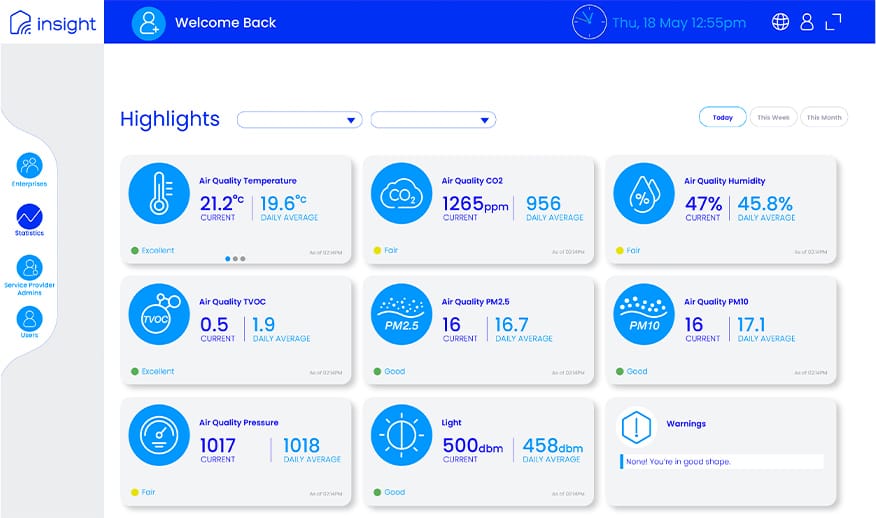
All sensor data flows into the Milesight Insight platform, where facility managers access live dashboards, historical trend analysis, and AI-generated recommendations for ventilation adjustments. When any parameter exceeds a configured threshold, the system instantly pushes alerts through multiple channels so staff can respond before passengers notice.
Results
- Enhanced environmental awareness — real-time data gave staff and management a shared, objective view of terminal air quality for the first time.
- Proactive operations — instant visibility and predictive recommendations replaced reactive spot-checks, enabling faster and better-targeted ventilation management.
- Healthier passenger experience — consistently maintained air quality improved comfort and satisfaction across all three airports.
- Energy efficiency and compliance — optimised ventilation reduced unnecessary HVAC runtime and ensured compliance with public health standards.
- Operational resilience — centralised alerts and management streamlined resource allocation across multiple terminal zones.
TAV Technology’s own assessment: “The Insight interface is very user-friendly, and the entire implementation has significantly improved efficiency in our operational processes.”
Why Malaysian Airports Need This Now
Malaysia’s airport network handles tens of millions of passengers annually and operates in one of the most challenging ambient environments on earth. The case for deploying the same IAQ monitoring approach is stronger here than almost anywhere else.
Tropical Climate Intensifies Indoor Air Quality Pressure
Malaysia’s year-round heat and humidity create a constant baseline challenge for indoor air management. When hundreds or thousands of passengers enter a terminal, the latent heat and moisture they bring raises CO₂ and humidity rapidly. KLIA, KLIA2, Penang International, Senai, and Kota Kinabalu International all have large, open terminal volumes with fluctuating passenger densities throughout the day. Without real-time sensing, HVAC systems run on fixed schedules or rough occupancy estimates — wasting energy during quiet periods and underperforming during peak ones.
MAHB’s Sustainability and Passenger Experience Agenda
Malaysia Airports Holdings Berhad (MAHB) has published commitments under its MAHB Sustainability Roadmap covering energy efficiency, carbon reduction, and passenger experience. IoT-based IAQ monitoring directly advances all three: it enables demand-driven HVAC (cutting energy use), provides auditable air quality data (supporting environmental reporting), and measurably improves the passenger environment. The same Milesight Insight platform used in Turkey can generate the compliance-grade reporting MAHB needs for its ESG disclosures.
Post-Pandemic Passenger Expectations
Air quality became a visible, discussed concern during the COVID-19 period and has remained so. Passengers increasingly notice — and share opinions on — the quality of the indoor environments they pass through. Airports that can demonstrate actively monitored, maintained air quality have a differentiator that shows up in passenger satisfaction surveys and operator ratings.
Rapid, Non-Disruptive Deployment
One of the key reasons TAV chose the Milesight LoRaWAN® approach was zero new cabling — critical in a live operational environment where disruption has cascading effects on flight schedules and passenger flow. The same constraint applies even more forcefully at Malaysian airports. A fully wireless deployment means sensors can be installed and operational within days, not weeks, without scaffolding, conduit runs, or terminal closures.
Scalable Across the Network
Malaysia’s airport network includes KLIA and KLIA2, eight other international airports, and 16 domestic airports, all managed or overseen under the MAHB umbrella. A standardised IAQ monitoring deployment — using the same sensor model, gateway type, and platform — can be rolled out across the entire network progressively, with centralised visibility from a single Insight platform instance. Data from Kuching can be compared against Penang; underperforming terminal zones can be identified and prioritised across the estate.
Where to Start
A practical entry point for Malaysian airports would be a targeted pilot covering the highest-density zones: international departure lounges, food and beverage concourses, and immigration halls. A deployment of 30–50 AM308L sensors with two or three UG63 gateways would cover a typical terminal zone and generate enough data within 60–90 days to quantify the ventilation inefficiency and build the business case for full-terminal rollout.
Getting Started
Riajati is an authorised Milesight partner in Malaysia. The AM308L sensors, UG63 and SG50 gateways, and the Insight platform are all available locally, with full support for deployment scoping, network design, and platform integration. We can help airports, airport concession operators, and facilities management teams scope a pilot that fits their operational constraints and budget.
Contact us to discuss an IAQ monitoring pilot for your terminal.
Source: Milesight — Real-Time Air Quality Monitoring in Turkish Airports