Case Study: Royal Pahang Golf Club, Kuantan — 120 Acres Protected by the Biral BTD-200
Why golf clubs have a lightning problem
Malaysia has the third-highest lightning activity in the world, and the risk spikes sharply during the inter-monsoon transitions in April–May and September–October. Over 100 people were killed by lightning strikes in Malaysia between 2008 and 2017.
Golf is one of the more exposed outdoor sports. A round of 18 holes puts players on open fairways for four hours or more, often carrying metal clubs, sometimes half an hour’s walk from the nearest shelter. When a convective cell moves in fast, the time between “first distant rumble” and “unsafe to be on the course” can be less than 15 minutes. That’s the exact window a good lightning warning system needs to close — and the reason forward-looking Malaysian courses are installing detection at the clubhouse level.
The site: Royal Pahang Golf Club, Kuantan
Royal Pahang Golf Club sits on Malaysia’s east coast in Kuantan, Pahang — one of the wetter parts of the country and directly in the path of the northeast monsoon. The site is a full 18-hole championship course spread across 120 acres, with fairways looping well beyond line-of-sight from the clubhouse. Any lightning warning system for a course this size has to cover the entire footprint from a single sensor.
The solution: BTD-200 on the clubhouse roof
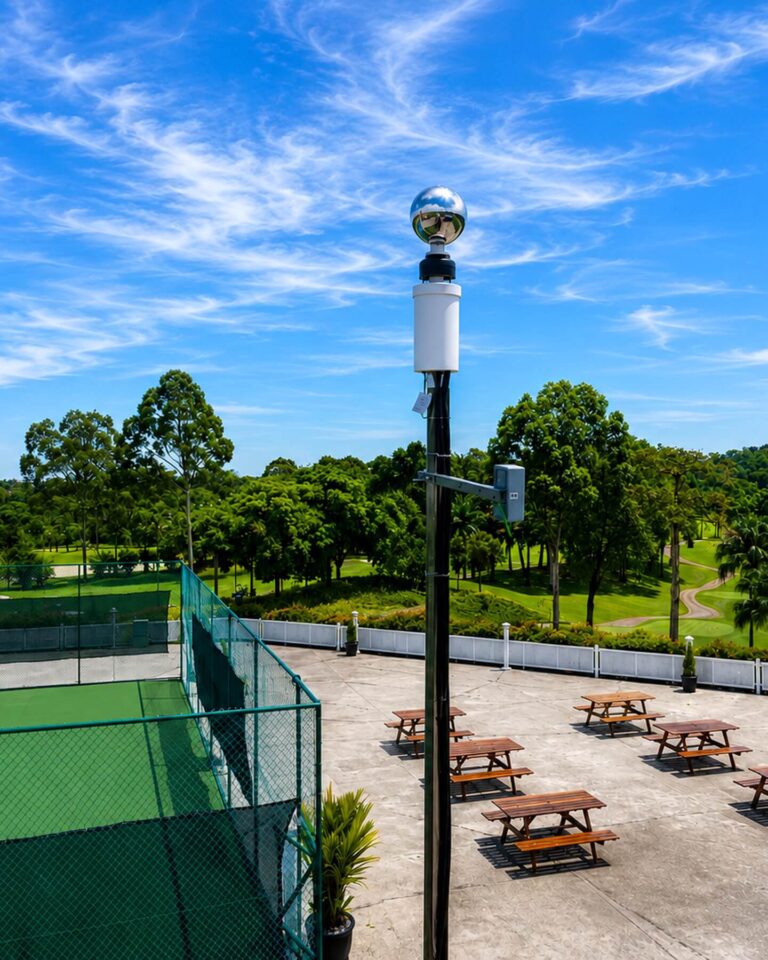
The club deployed a Biral BTD-200 Lightning Warning System — the same 35 km-range self-contained detection unit used at Malaysia’s National Stadium at Bukit Jalil. The BTD-200 uses a quasi-electrostatic detection principle, sensing the slow buildup of atmospheric electric charge that precedes a strike — which means it warns of a developing thunderstorm before the first cloud-to-ground flash, not after.
The sensor was mounted on the rooftop of the clubhouse, giving it a clean electrostatic view over the whole 120-acre site. From that single sensor, one BTD-200 covers every fairway, every green, and every practice area.
Three-station Lightning Works network
The detector feeds Biral’s Lightning Works PC application, which displays real-time lightning proximity on a digital map. Royal Pahang runs Lightning Works on three PCs: one hub in the operations office, and two additional stations in different rooms — pro shop, starter’s hut, F&B — so any staff member on duty can see the same threat picture without having to walk across the building to check.
Tiered auto-alerting: 35 km warning, 9 km alert
The alerting is set up in two tiers based on strike proximity:
- Lightning within 35 km — WARNING. Staff go on standby. Player groups are informed that a storm is in the region. Groundskeeping equipment is moved indoors. F&B prepares to shelter guests.
- Lightning within 9 km — ALERT. The threat is close enough that immediate action is required: air-horn or PA evacuation of all players from the course, cart marshals dispatched to pick up the furthest groups, doors to sheltered structures unlocked.
This two-tier structure is critical for golf specifically, because a hard “evacuate now” only makes sense when it’s really necessary — nuisance evacuations cost the club money and player trust, so a graduated warning that gives 20–30 minutes of standby time before an evacuation alert is the operationally sound pattern.
Why this pattern travels well to other Malaysian courses
Malaysia has more than 200 golf clubs across the peninsula, Borneo, and the islands — all of them exposed to the same tropical storm activity, all of them wrestling with the same “when do we call it?” decision on any given round. The Royal Pahang deployment is one repeatable blueprint: one BTD-200 on the clubhouse roof, Lightning Works on 2–3 operations PCs, a two-tier auto-alert profile tuned to the local storm approach speed. Sirens or air-horns tied to the 9 km alert threshold complete the setup.
For much larger sites (multi-course resorts, airports, wind farms), the BTD-300 steps the coverage up to 83 km with the same detection physics.
Talk to us
Riajati is the current authorised Biral distributor for Malaysia. If your golf club, resort, sports complex, school, industrial site, or event venue is looking at a lightning warning setup, get in touch — we’ll help you scope the right sensor, coverage plan, and alerting profile for your site’s specific risk pattern.
Source: Biral’s original case study. Original Royal Pahang deployment credit: Biral and its local partner Jebsen & Jessen Malaysia. Riajati Sdn Bhd is the current authorised Biral distributor for Malaysia.